A business password manager is not just a place to save logins. It should give employees a safe way to use unique credentials, reduce insecure sharing and let an owner remove access when someone leaves. The rollout process matters as much as the app selected.
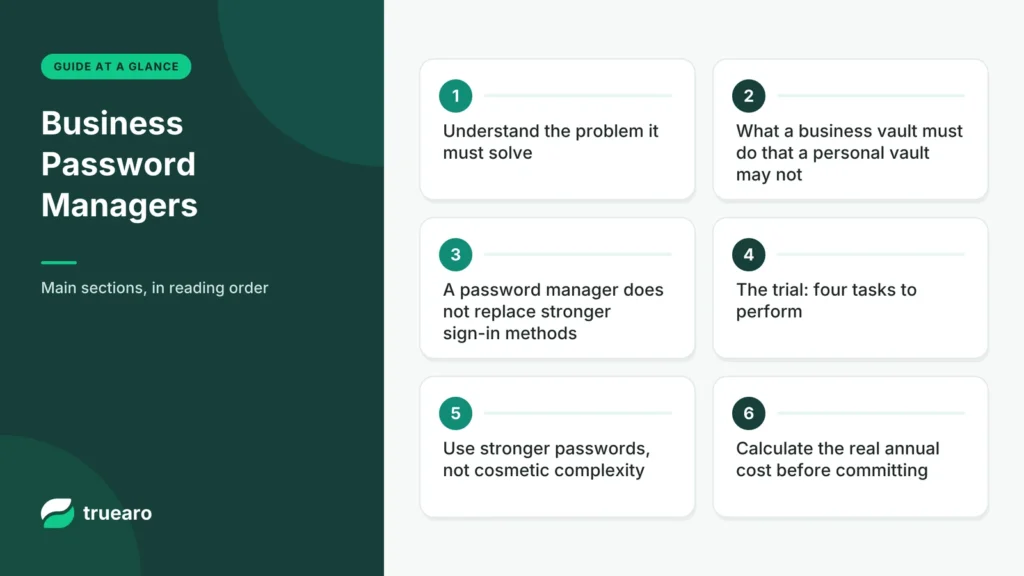
Understand the problem it must solve
List shared systems such as domain registration, payment processors, advertising accounts, social channels, hosting and customer support. Identify which services support individual staff accounts; use those instead of shared passwords wherever possible. A password vault should not become an excuse to give everyone the same administrator login.
Ask the vendor about encryption design, admin controls, device support, vault access history, authentication options, emergency recovery, exports and the procedure for closing an account. Avoid conclusions from marketing labels alone. Read the technical documentation and independent security information available for each product.
What a business vault must do that a personal vault may not
For a freelancer, storing unique passwords securely may be enough. In a company, the harder questions concern ownership and permissions. Who can access the payment processor? Who approves a new employee’s access? What happens when the person who created the vault leaves? A team plan is worth paying for only when its administrative controls solve these problems, not because it has a longer feature list.
Start with a simple access map. Keep financial systems, infrastructure, marketing tools and everyday collaboration accounts separate. An employee who schedules social posts should not automatically inherit access to domain registration or cloud billing. Give people the permissions they need for their work, then review exceptions. Where a service supports named users with role-based access, prefer those accounts over distributing one shared administrator password.
| Capability | What to verify during a trial | Warning sign |
|---|---|---|
| Shared collections | Can staff use a credential without administering the entire collection? | Every invitee receives broad vault access. |
| Employee removal | Can an administrator revoke access promptly and review outstanding shared credentials? | Removing a user leaves no clear record of what was shared. |
| Account recovery | Is the recovery process documented, restricted and usable when an admin is unavailable? | One employee holds the only recovery method. |
| Audit information | Can admins investigate invitations, access changes and unusual activity within the plan? | Important logs require an unexpected upgrade. |
| Device support | Do browser extensions and mobile apps work with the team’s actual devices? | Staff regularly copy passwords into unsecured notes. |
| Exit options | Can credentials be exported securely and migrated without abandoning essential records? | The vendor makes account closure difficult to explain. |
Not every business requires enterprise single sign-on, directory provisioning or advanced compliance reports. Those can be valuable for larger teams, but a small company may get more benefit from basic role controls, reliable support and a clearly tested recovery process. Compare the plan tier that contains the required controls, not the advertised starting price.
A password manager does not replace stronger sign-in methods
A manager helps people create and use different passwords for different services. Multi-factor authentication adds protection if a password is exposed. Passkeys can provide phishing-resistant sign-ins on supported services, but availability, device sharing and account recovery differ by provider. The updated NIST authentication guidelines distinguish phishing-resistant cryptographic authentication from methods that depend on typing a one-time code into a website.
For the organization’s most sensitive accounts, consider security keys or other phishing-resistant MFA where the provider supports them. Do not store the only backup factor inside the same vault without evaluating the consequences of losing vault access. Our passkeys rollout guide covers the device and recovery decisions in more detail.
The trial: four tasks to perform
- Create a shared collection that a normal employee can use but cannot administer.
- Invite a test employee with multi-factor authentication and check the first-login experience.
- Remove that employee and confirm shared access is revoked.
- Practice recovery using the company’s documented procedure, without exposing recovery secrets.
Consider recovery carefully. A team may be locked out when the only person who controls an administrator account loses their device. On the other hand, weak recovery processes can bypass otherwise strong security. Assign two appropriate administrators, protect their accounts with strong authentication and store recovery procedures separately.
Use stronger passwords, not cosmetic complexity
Current NIST digital identity guidance emphasizes longer passwords and screening against compromised choices rather than arbitrary forced character patterns. Let the manager generate unique credentials for each service; avoid reusing passwords across business accounts. Multi-factor authentication adds a separate protective layer. Passkeys may be an option where supported.
Calculate the real annual cost before committing
Suppose a five-person company compares two plans costing $4 and $8 per user each month. At the stated prices, the subscription difference is $240 a year: five people multiplied by twelve months multiplied by four dollars. That is not a vendor quote, and taxes, annual discounts and minimum seats may change the bill. The cheaper plan is only cheaper if it includes the administration and recovery controls the company needs. Also budget a little staff time to migrate credentials and remove risky old sharing habits.
Offboarding requires more than deleting an employee
On an employee’s last working day, revoke their vault membership and account sessions. Then identify which credentials they knew or could copy while employed. Rotate sensitive shared credentials when warranted, revoke application tokens, remove delegated access inside the underlying services and check whether account recovery details still point to that person. Keep a dated record of completion. A password manager cannot revoke a copied API token from a separate application on its own.
One month after rollout, review whether people are actually using the vault. Unused accounts, passwords still sent through chat and unmanaged personal vaults are practical signals that the process needs fixing. A security purchase succeeds when everyday behavior changes, not merely when invoices are paid.
Protecting shared credentials is only part of securing remote access. The VPN and zero trust access comparison discusses how to restrict the resources employees and contractors can reach.
A seven-day rollout
On day one, choose owners and inventory critical systems. On days two and three, configure administrative access and migrate the most sensitive credentials. During days four and five, teach staff to recognize fraudulent login pages and use the vault without copying secrets into chat messages. On day six, test offboarding. On day seven, review shared items for excessive access.
Keep the plan lightweight: employees need a short explanation of where credentials belong and who approves access. The FTC’s small business cybersecurity resources also recommend authentication and protective controls. No password manager can prevent every attack; pair it with training, backups and sensible permissions.